Thursday, October 29, 2009

A Few More Birds


We are not banding tonight due to windy and rainy weather. Two nights ago on the 27th we banded 5 Northern Saw-whets and had a NSWO foreign encounter. If you remember from earlier blogs an encounter is a bird that is already banded. A foreign encounter is a bird banded from a different location. The four other encounters we have had this season were not foreign, all banded here at Whitefish Point. We don't know where the foreign encounter was banded. It will be interesting to find out where it was originally banded.

Only a couple more nights of banding. The weather forecast isn't looking good. Maybe Saturday night if it isn't too windy.

Totals: 3 BDOW, 2 BOOW, 1 LEOW, 123 NSWO

Monday, October 26, 2009

Quiet Times


Not much to report on. I just felt like I should update the blog. We have not banded a new bird since the 17th. This can be mainly attributed to crummy weather. We have been having more rain and wind. Oh well ,what can you do?

A visitor to the point today saw a Long-eared Owl roosting. We were hoping it would stick around and get caught in our nets. Unfortunately, we had to close the nets due to intermittent rain and strong winds.

I was looking through my pictures and found this one of a Northern Saw-whet about to take off from Tim's arm. Just look at that little owl, how could you not love them?!

Our last night of banding is on Halloween. I hope we get to see a few more owls before the 31st. We'll see.

Totals: 2 BOOW, 3BDOW, 1 LEOW, 118 NSWO

Monday, October 19, 2009

Cold Weather Brings Cool Birds


Strong winds kept us from opening last night but we are back at it tonight. It's been hit and miss of late. Cooler temperatures caused some movement over the last five days. On the 15th we caught 6 (all before 11pm so it seemed like a slow night), 16th we only caught two (both before 9pm so it seemed like a horribly slow night), 17th was our best night with 12 NSWOs and our second BOOW of the season! Tonight is shaping up to be a long one. It's 11pm and we have nothing to show for our efforts. I guess south winds and warmer weather don't make these little guys want to fly across a big lake. I sure hope we get a few...closing time is a long way off.--Tim

Thursday, October 15, 2009

Past the 100 mark


Tonight we banded the 100th owl of the season! We just finished banding our third Barred Owl of the season. This owl was much feistier than the two others we banded. Right after banding the Barred we had the second Northern Saw-whet of the night. Sometimes I forget how small the Saw-whets really are.

The picture above was the second Barred Owl that we banded. It was nice enough to perch so I could get a photo of it with the lovely fall colors in the background. Speaking of the fall foliage- it is really pretty up here now, supposedly at "peak" color.

Tonight is the first night that the thermometer gave a reading below zero (centigrade). Burrr. I'm sure the owls like it since they are molting in new body feather to keep them toasty in the upcoming months. That is all for now.

Total owls banded: 97 NSWO, 3 BDOW, 1LEOW, 1BOOW

Friday, October 9, 2009

Barred Owls and bad weather


Lucas with the first Barred Owl of the season.


Second Barred Owl of the season.


Britta's parents with us at Tahquamenon Falls

The last two weeks have been pretty spotty for us due to the weather. We've had many nights when the nets weren't open at all and a few more that we had to close early or open late (or both). Yet between the gusty nights and showers we've still been catching a few birds, including our first two Barred Owls. The count coming into tonight stands at 84 owls banded; 80 NSWO, 1 LEOW, 1 BOOW, 2 BDOW. Four species, not to shabby. We were hoping to catch a short-eared or a hawk owl early tonight because both were seen on the point today, but those long shots are not looking like they'll pay out. Although we were lucky enough to see the N. Hawk Owl (1st for both of us! I'm sure Chris and Tom have posted some excellent pictures). Tonight has been fairly slow although we've had two out of season recaps. Both NSWOs banded here, one in spring 08 the other this past spring.

Even though the timing wasn't the best due to the weather, we've had some nice visits from friends and family. Britta's parents made it up for four nights. We were only able to open one of those nights and then only after mid-night, but we did catch a few and they were able to see one Saw-whet. Our close friend Lucas also came to visit. We worked with him in Ontario this past summer. He was with us for our first Barred Owl capture and a fair number of Saw-whets. He was also lucky enough to see all the great birds that showed up on the point today. He also shamed me in cribbage between net runs (four games to one with a skunk to boot) We were very happy they all chose to make the long trip to see us.

Looks like we may have a early snow storm coming in this weekend. We'll keep you posted.

Sunday, October 4, 2009

Look what we banded tonight!

A Boreal owl! This is the first Boreal banded this fall. Eight lucky visitors were present to share the excitement with us. This was the first Boreal for Tim and I as well as the majority of the visitors. After the recent rainy weather we were excited to actually be banding tonight and then we were happily surprised with a new species.


Total birds banded 72 NSWO, 1 LEOW, 1 BOOW.

Monday, September 28, 2009

Rainy Night

We are not banding tonight due to the heavy rain and strong winds. We are glad to have the night off and will be ready to go once the weather breaks. Tomorrow evening isn't looking promising for banding either. We are hoping for a big push after this storm passes on Tuesday or Wednesday night. We will see....

Last night we ended up with 11 Northern Saw-whets and one Saw-whet encounter. The encounter was a bird banded here at Whitefish Point by Chris and Nova during the Summer 2009 banding effort. This bird was a juvenile when first banded and is still in the area. Interesting stuff.

Totals: 65 NSWO, 2 NSWO encounters, 1 LEOW

Thursday, September 24, 2009

Windy night


Things have picked up a bit the last two nights; 12 NSWO last night, nine the night before (plus a flying squirrel). Tonight is a bit slow. In fact you couldn't get any slower...none so far. It's pretty windy so we have the Saw-whet triangle closed which of course isn't helping things. Seems like it may be getting a little calmer out there though, so we may open back up. Season totals are; one LEOW, 40 new NSWO and one NSWO encounter. An encounter is an out of season recapture. In this case it was a HY bird banded by Chris and Nova this summer. Britta and I don't seem to be annoying each other overly much yet (guess I shouldn't speak for her) at least not anymore than normal (we've been together awhile). We're both really enjoying our first season of mist netting owls and are happy to be at the Point.--Tim

Monday, September 21, 2009

First Long-eared of the season


This is our first blog from the banding station in the wee hours of the morning. It has been a slow, windy night at the point, but a good one. We had our first Long-eared owl (LEOW) capture tonight!! We also had the first adult Northern Saw-whet owl (NSWO) capture. The LEOW was a hatch year bird, on the skinny side, but still looking good. They are such beautiful birds with an amazing pattern on their feathers.

Totals for the season: 18 NSWO, 1LEOW

Thursday, September 17, 2009

The 2009 fall banding season is off and running. The first night of banding on the 15th of September was unsuccessful with zero captures. The second night was much better with a total of seven Northern saw-whet owls banded. One of those still had its juvenile plumage. One other highlight for the evening was a feisty silver-haired bat caught in one of the nets.

Tuesday, August 25, 2009

juvenile Saw-whet molting into adult plumage

Northern Flying Squirrel balancing on a net


The summer owl banding season has wrapped up. After the last post things really came to an unusually abrupt halt. After banding 6 juveniles on the 12th, just one juvenile and one adult were banded the rest of the season. I spent the last week of the season sitting out at the nets repairing the holes made by bats and Flying Squirrels. It's not easy tying knots in these fine nets while contending with swarms of mosquitoes and moths. We ended up banding 257 Saw-whets and 3 Long-eareds. Of the 257 Saw-whets 189 were juvenile and 68 were adult. While the juvenile numbers are well below the success of 2007, they are more than 3 times better than last summer's results. Once we get all the season's data entered and the report done we will do a final post on the season. We once again want to thank all who pledged to this spring's WPBO Staff Birdathon in support of this project.

Thursday, August 13, 2009

molting juvenile Saw-whet Owl
While things did pick up a little bit last night, it was not the push we were hoping for. Six juveniles were banded including the one pictured above. This bird's post-juvenile molt has progressed much farther than any other we have seen this season and its facial disc is nearly completely in adult plumage. We have recently been catching a relatively high percentage of juvenile that have not even begun their molt into adult plumage, which is odd at this late date. The last two nights have also been odd in the fact that all captures have been in the first half of the night, then we are not getting any birds during what is typically the peak period of the night. Conditions seem favorable again tonight, hopefully it will be good.

Wednesday, August 12, 2009

Former WPBO owl bander Paul Dziepak
& son Caleb with juvenile Saw-whet
Weather conditions last night seemed prime, but only 3 juveniles were banded. We were only able to get a few hours in during the last 3 nights due to weather, and 0 birds were banded.
The weather forecast for tonight looks very good and we're holding our breath in hopes that things will pick up again. We were visited last night by Paul & Caleb Dziepak. Paul worked at WPBO in the early 90's and did some of the first fall owl banding at the Point. It's always interesting to hear stories from folks who have spent seasons at the Point.

Thursday, August 6, 2009

Saw-whet Owls, juvenile left & adult right

Long-eared Owl replacing it's flight feathers

The last four nights have produced decent results. Two adult Saw-whets banded on the 2nd make this the best summer yet for adults. Nineteen juvenile Saw-whets represent a bit of a slow down, but we hope that things will pick up again with improved weather conditions. In the previous 3 summers we have banded 1 to 4 Long-eareds, so we're happy to have banded 3 already this month. While we are fortunate enough to band a large number of Long-eareds in spring, 138 were banded this spring, captures in the summer provide a rare opportunity to see them during their annual molt period. All 3 banded this summer have been adults in active molt. There was also a nice turn out for Sarah's night hike, and we'd like to thank the folks who supported WPBO by adopting the night's first juvenile Saw-whet for their granddaughter.

Sunday, August 2, 2009

Season's First Long-eared

Long-eared Owl

August got off to a very nice start. First off, just after posting yesterday's blog we received an email on an owl banding list-serve that we belong to. It listed a band number from a male Saw-whet caught at its nest in Abitibi, Quebec. For the second summer in a row Jonathan Gagnon recaptured a Saw-whet at its nest that we banded here this spring. We don't know the exact location of this nest box study, but this region is about 300 miles to our northeast. We banded this bird on April 23 and on Friday night it was delivering food to chicks that were about 20 days old. It's amazing to find out where birds banded here are nesting. Thanks to Jonathan we have found out where two of our spring Saw-whets headed to nest. It's also interesting to know that while at least one bird that we banded here this spring is still attending to young that are about 10 days from fledging, we have been catching juveniles for nearly a month.

After that exciting news we also had a good night banding. After a short rain delay we were able to open and favorable conditions produced the first Long-eared of the summer and 20 juvenile Saw-whets. We are now over 200 owls on the season and the juveniles are going strong. Between the news of the recapture and the night's banding it was a good day/night.

Saturday, August 1, 2009

A decent July

molting juvenile Saw-whet

The 1st month of the season wrapped up last night. The juveniles really picked up in the last few nights and we're happy with the results so far. We banded 196 Saw-whets in July; 65 adults and 131 juveniles. After banding just 60 juveniles all of last summer we're obviously happy to see that the breeding success of Saw-whets has begun to rebound.
Given that 78 of the juveniles were banded in the last 5 nights, we're feeling optimistic about early August. We're beginning to see some juveniles at more advanced stages of their molt into adult plumage. We always enjoy the period when the juveniles are at varying stages of this molt. The photo up top shows a juvenile that has molted in its ear-flaps, about half of its adult facial disc, and has a few adult breast feathers showing.

Tuesday, July 28, 2009

The weather continues to hinder our efforts. The above photo shows the lighthouse in some of the heavy fog that has been a common occurrence during recent nights. After 4 nights of barely being able to get a couple hours in we were finally able to run for a full night again last night. While we could see lightning from a steady stream of thunderstorms passing just to our south, light southwest winds produced 13 juvenile and 1 adult Saw-whet. Despite all of this month's down time we have now surpassed last summer's juvenile results with almost a month to go in the season.

The above juvenile Saw-whet still has some downy tufts on its feather tips. These tips have worn of the majority of the juveniles that we catch, so we assume any birds that still has them are particularly young.

The underside of the leaves of Silver Maples light up beautifully at night in our LED headlamps.

Rosy Maple Moth

plume moth species

Monday, July 20, 2009

1st push of juveniles

What in the world?
After scattered rain and/or high winds prevented us from opening on Friday and Saturday night, favorable conditions last night produced 15 juvenile and 5 adult Saw-whets. Considering the fact that the peak for juveniles last summer was 13 in mid-August, the banding of 15 last night is very promising.
During the last two summers adult captures were highest in early July and slowed to a trickle in late July and August. The drop off in adult numbers began soon after we started to see them actively molting their flight feathers. The top photo is a close up of the pin feathers of the tail of an adult that is currently replacing its tail. The photo below is of the same tailless bird, that's its white undertail coverts sticking out where the tail should be.

Wednesday, July 15, 2009

Summer Project's Thousandth Owl!

The summer project's 1,000th owl!

We had to keep an eye on the radar all night, but managed to get another full night in before the rain started at sunrise. It was another decent night and 6 juvenile & 5 adult Saw-whets were banded. One of the night's juveniles was the 1,000th owl for the summer research project. Given the unique nature of this study, and the fact that it began in 2006 when we only ran for 3 weeks we are extremely pleased with these results. We really don't know what the rest of the season will bring, but we're coming up on what was the peak period for juveniles in 2007 and 2008. With some luck we may even band the 1,000th juvenile for the project this season. Even having this as a possibility far exceeds the expectations we had when we started the summer research, Whitefish Point continues to amaze us. We also had a Silver-haired Bat in the nets tonight.

Tuesday, July 14, 2009

Juvenile Saw-whet Owls
For just the 5th time this season the weather actually allowed us to get in a full night's banding. It proved fairly productive and we banded 5 adult and 5 juvenile Saw-whets. The fact that I accidentally found myself within 30 feet of a bear in the backyard of the staff housing recently has caused us to be extra alert in the net lanes the last few nights. Eye level eyeshine in our headlamps really stopped us in our tracks tonight........glad it was deer.

Monday, July 13, 2009


After waking up to the same high winds that shut us down early last night our morale got a bit of a boost tonight. The wind finally died down and we were able to open around 1 AM to get a few hours of banding in before sunrise. While we ended up with a modest 4 Saw-whets, we were thrilled that 3 of them were juveniles.
While we have now banded over 800 juveniles since we began the summer research in 2006 only a handful of these had yet to begin their molt into adult plumage. The juvenile pictured in the top photo is one of these birds and we purposely chose a photo with it's eyes closed to show it's eyelid feathers still molting in. The bottom photo is of an adult that has dropped the feathers on it's tarsi and feet. While we rarley see active flight feather molt on Saw-whets in spring, we regularly see adults beginning to drop the feathers on their legs and feet in late May. It is interesting, to us anyway, to see Saw-whets at similar stages of molt in May and July.

Sunday, July 12, 2009

High winds, rain, thunderstorms, and hailstorms have resulted in a lot of down time over the last week. Over the last 5 nights we've managed to get in 2 complete nights, and were able to run for a couple hours on 2 additional nights. The owls have been relatively slow, but 8 adult and 1 juvenile Saw-whets were banded on these 4 nights. We have continued to receive pledges for this spring's WPBO Staff Birdathon. The birdathon has now raised $8,154 for the summer owl research, more than meeting our goal of 8,000! Thank you all for the amazing level of support you have provided. Hopefully the weather will become more cooperative and the owls will pick up a bit. As always, don't forget about Sarah's Thursday and Saturday evening owl programs. The programs are given at 9:30 PM in the Owl's Roost Gift Shop.

Sunday, July 5, 2009

1st Juvenile!

Juvenile Northern Saw-whet Owl
"Nutmeg"
The season's second night was another enjoyable and productive one. We went into Paradise for the fireworks, the town does a great job with the 4th of July, then back to the Point for the banding. Sarah had a nice turnout for a special "late night" owl presentation, and the first net check produced 4 Saw-whets, including the season's 1st juvenile. A group of the visitors adopted the juvenile, and after some very amusing deliberation settled on naming her Nutmeg. We ended up banding 15 adults and the one juvenile Saw-whet last night. Thanks for supporting WPBO through the sponsor-a raptor program, and to all who attended Sarah's owl program tonight.
This is just the 3rd year that we have begun the
summer season on July first. In 2007 we banded the season's 1st juvenile on the first night of the season, but last year the 1st juvenile did not show up until July 15. As much as we love all the Saw-whets in the spring, there is something very special about seeing the summer's first juvenile. It is amazing to know that these birds were eggs just a couple of months ago.

Saturday, July 4, 2009

1st night of the summer


After high winds kept us from opening during the 1st two nights of the season, we were finally able to run last night. We banded 14 adult Saw-whets, and captured one that was already banded. While we have banded as many as 48 juveniles in a night during previous summer seasons, this is the highest total for adults banded in a night during the summer.
It's always tough lasting through the 1st night of the season, but its sooooo much easier in the summer than it is in the spring. The nights are much shorter and we say things like "look at the all these blueberry buds", as opposed to "I bet there's 4 feet of snow here", or "I can't feel my fingers". The major complaint in the summer is the mosquitoes, but the cold spring has continued into the summer and near freezing temperatures last night kept them at bay. It's great to have the 1st night of the season under our belts and we can't wait to see what the season brings.
Don't forget about Sarah's Thursday and Saturday evening owl programs if you're coming to the Point this summer.

Monday, June 29, 2009

We're just 2 nights away from beginning the 4th season of summer owl research. During the first 3 seasons 932 Saw-whets, 7 Long-eareds, and 1 Barred Owl were banded. Of the Saw-whets, 798 have been juveniles. Whitefish Point remains the only site at which a movement of juvenile Saw-whets has been found. We're hoping that Saw-whets are having a better breeding season regionally than they did last year. Last summer's results were low and just 60 juveniles were banded, compared to 538 in 2007. Two of the larger breeding studies in Canada reported low reproductive success this season, but another smaller study reported good success. The opportunity to document an unknown aspect of Northern Saw-whet Owl biology is a rare one, and we feel extremely fortunate to be able to continue this study.
We again want to thank all who have supported this research. For the second year, the Baillie Fund provided us with generous support. Even though the 2009 WPBO staff Birdathon was conducted in May, we continue to receive pledges. This year's birdathon has now raised over $7,200 for this summer's research. In total over $9,700 have been raised, thank you all for your generosity.
Sarah will be giving owl presentations on Thursday and Saturday nights at 9:30 PM. The programs include a powerpoint presentation on the owl research conducted by WPBO, and close up views of any owls captured during the program. It is a unique opportunity to have a chance to see a Saw-whet in its beautiful juvenal plumage, which they only have for the first few months of their lives. This plumage has earned them the affectionate name of "chocolate teddy bears". The below photos are from previous summer seasons.


Juvenile Northern Saw-whet Owl


Juvenile (left) and adult (right) Saw-whets

Thursday, June 4, 2009

Another Great Spring For Owls

Before we start the summary of this spring's owl banding, we have to thank all of you who supported the 2009 WPBO staff birdathon. Your support increased 300% over last year, and over $6,000 was raised for the summer owl research! With the additional $2,500 we received in grants and private donations, we have raised the full dollar amount necessary for the summer season. This is the first time we have been able to accomplish this, and we are extremely grateful. Thank you, thank you, thank you!
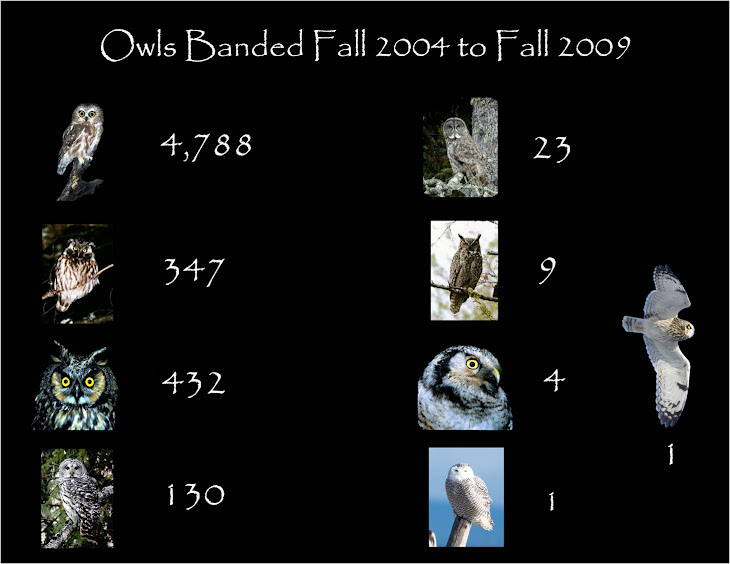
The spring owl banding season came to a close on the night of May 29. With 773 owls of 7 species banded, and the recapture of another 34 owls that had been previously banded, it was another productive season. The banding results listed below once again demonstrate the importance of the role that Whitefish Point plays in owl migration.
548 Northern Saw-whet Owls
73 Boreal Owls
138 Long-eared Owls
1 Short-eared Owl
4 Great Gray Owls
7 Barred Owls
2 Great Horned Owls

While the overall number is down from the 1192 owls banded last spring, it was a very successful season. The reason for the drop off is that Saw-whets had a poor breeding season last year. The number of young Saw-whets banded dropped from 673 last spring to just 149 this spring. While the number of young Saw-whets was down, more adults were banded this year. The 139 Long-eareds banded represents the 3rd highest season total for WPBO. We had hoped for a better Boreal season, but 73 is a very respectable number. The peak night occurred on May 1st, on which night 25 Saw-whets, 12 Boreals, 20 Long-eareds, 1 Short-eared, and 3 Barreds were banded, and a Great Gray was seen.
Whitefish Point is such an amazing place. This season's results simply reinforce the fact that the owl migration that occurs here is one of the most significant and diverse in North America. In addition to the 7 species that were banded, Snowy Owls were also observed several times this season. We will never forget the sight of two Snowies sitting together at the tip, or of one sitting in a pine at the entrance to the owl road. Given the variety of owls this spring, it is somewhat surprising that no Northern Hawk Owls were observed. We thank all of you who visited for your enthusiasm, encouragement, and support. We are currently enjoying the opportunity to walk among the living for a while before going nocturnal again during July and August. Don't forget that Sarah will be running the evening owl programs during the summer season.

Great Gray, Boreal, & Saw-whet Owls

A Boreal Owl's feathered feet

Long-eared & Short-eared Owls

Barred Owl

Great Gray Owl

A Great Gray's underwing

Great Horned Owl

Snowy Owl

Sunday, May 24, 2009

Saw-whet & Great Gray Owls

Following our last post wind and/or rain shut us down for 3 out of 4 nights, but things have picked up a bit again. Over the last 3 nights we have banded 39 Saw-whets, 1 Long-eared, and 1 Great Gray. The Great Gray was actually the 700th owl banded this season. While the folks who hung around after attending Sarah's evening owl presentation were treated to close up views of Long-eared & Saw-whet Owls, the Great Gray unfortunately showed up later in the night. We thought the Great Horned had left, but it continues to be seen perched on the lighthouse most nights.

Saturday, May 16, 2009

Great Horned Owl

The owls have continued to be slow but steady. We were able to open on 6 of the last 8 nights and banded 37 Saw-whets, 1 Boreal, and 3 Long-eareds. The fact that weather conditions on several of these nights were very favorable leads us to believe that the owl migration is likely to remain slow for the rest of the spring. The Great Horned that has spent weeks hunting from the lighthouse has not been seen the last few nights and may have finally moved on. However, as was proven yesterday you never know what might show up. A very nice couple told us about a Snowy Owl sitting at the entrance of North Shore Rd. We've been fortunate enough to see many memorable sights here, none more so than a Snowy perched among the pines. The stormy weather the previous night had produced a nice fallout of songbirds, and apparently a somewhat wet and disheveled Snowy Owl. That night a group of Brits had the Snowy fly over them on the hawk platform and head out over the lake during the evening flight, we're jealous.


Thursday, May 14, 2009

Bird-a-thon 2009

Dear all of you avid blog followers,

If you have enjoyed the various blog posts this season, now is your chance let us know by pledging to our staff Bird-a-thon. This is a great way to ensure that there will continue to be blog posts in the future to amuse and amaze you.

This is the 3rd year for the WPBO spring Bird-a-thon fundraiser. Last year the Bird-a-thon pledges were the single biggest contributor to the summer owl research project. The total amount of funding required for this program is $8,000. In the last month, we have raised $7,060 towards our goal, mostly through Bird-a-thon pledges. We are so close, please consider becoming a sponsor!
At the end of May, WPBO staff known as the “Northern Saw-whats” team will record the number of bird species seen in the Whitefish Point Peninsula area during a 24 hour time period. We hope to see about 100 species. You can choose to pledge per species or donate a fixed amount. All pledges collected will directly support the summer owl research at WPBO. Sponsors will receive a written account of our day, a species list and information on our summer research. Anyone who donates over $150 will receive a juvenile saw-whet adoption package, including a photo of your owl, banding information, and adoption certificate.

Be the first to pledge from this blog post! Send your name, address and phone # along with the amount you would like to pledge to wpbostaff@gmail.com, or by snail mail to:

WPBO Birdathon
16914 N Whitefish Point Rd
Paradise, MI 49768

Thursday, May 7, 2009

After the really nice push of birds during the first 3 nights of May, things really slowed down. During the last 3 nights 11 Saw-whets and 3 Long-eareds have been banded. An adult Saw-whet banded last summer was also recaptured.

Long-eared vs Short-eared

Long-eared on left & Short-eared on right.

There is an owl related identification issue that comes up every spring. How do you tell a Long-eared (LEOW) from a Short-eared (SEOW) in flight? This becomes more difficult, often impossible, as night falls. In the spring as many as 80 LEOW/SEOW have been seen during a single evening owl flight. At Whitefish Point it is assumed that the vast majority of these are Long-eareds. From spring 2007 to the present date 245 LEOW have been banded in the spring, but the SEOW banded on May 1 was just the 2nd to ever be banded by WPBO. Typically only a handful of SEOW are seen, and these are typically seen by the hawk and/or waterbird counters. That being said, both species occur here and this often poses identification issues.
These species represent the two North American owls of the genus Asio. They are extremely similar in shape and flight style. However, SEOW have slightly pointier wings, and are heavier than LEOW. These factors result in SEOW often appearing more steady, and slightly less buoyant in flight than LEOW. Given proper looks these species are easily seperated by plumage. However, there are plumage variations within both species that can make identification from a distance or with just a quick view more difficult.

LEOW: Probably a male. This bird lacks the buffy tones of many LEOW on its underparts. As in all LEOW the dark barring extends from the breast through the belly. The facial disk of Long-eareds is very often more richly colored redish-brown than on SEOW, but some males are very pale.

SEOW: Streaked underparts, streaking is thickest on the breast, becoming thinner on belly. The buffy color on the underparts extends to the belly on this individual.

SEOW: This is a pale individual. The heavy streaking and buff tones are limited to the head and breast. The streaking becomes thin along the flanks and belly. Also notice the pattern of the black in the wingtips and the carpal patch, the black spot between the bend in the wing and the wingtip.

SEOW: Another pale bird. The "raccoon eyes" shown by SEOW are quite visible in both of the above photos. Again, notice the thin streaking on the belly.

LEOW: This is a buffy female. The rich coloration and barring on the breast and belly are strikingly different from the SEOW pictured above. However, note that LEOW show a large carpal patch. Field guides regularly mention the carpal patch as a field mark for SEOW, but often state that it smaller on LEOW, or simply omit it all together. Also note that like the LEOW, all owls with ear tufts fly with their tufts down.

LEOW: A paler bird, but the barring on the underparts are very different from the streaking on a SEOW. Notice how pointed the right wingtip looked as this bird was gliding into a headwind.

The above photos show how strightforward identification can be when afforded good looks in ideal conditions. However, these birds are often seen fleetingly, distantly, or during the evening flight when no plumage detail can be seen.

As stated earlier, SEOW have slightly more pointed wingtips and are a bit heavier than LEOW. This means that on average SEOW tend to be slightly steadier in flight than LEOW. That being said, these birds are extremely similar in shape and flight style. Think of it as trying to tell a Broad-winged from a Red-shouldered, or a Peregrine from a Prairie Falcon as they fly by at night. The bird on the left in the above composite is a SEOW. The middle and right photos are both shots of single bird. This bird was photographed during an evening owl flight, and is most likely a LEOW. It does illustrate how a bird can shange the shape of its wingtips within seconds as it goes from a soar to a glide.
I'm sure this is enough for most of you. I suspect most stopped reading before here. However, for those of you who are saying, "don't stop now, I was almost asleep", there's more on the variation among these species below.

LEOW: A particularly buffy female. Notice especially the buffy tones in the secondaries, and the underwing & undertail coverts.

SEOW: Note the pointier wingtips when compared to LEOW. This bird is paler than the female LEOW above, but buffier than the male LEOW below. Also note the dark wingtips with fewer dark bars on outer primaries than on LEOW.

LEOW: A pale male, very white in the underwing and undertail coverts.

The 3 photos above demonstrate how the blanket statement made by some field guides that LEOW are buffier than SEOW is misleading. LEOW may be buffier on average, and females are often much buffier than any SEOW will be, but males may be paler than some SEOW.

SEOW upperside: Note that the tawny coloration of the panel at the base of the primaries continues through the secondaries, and throughtout the spotting and streaking of the upperparts.

LEOW upperside: LEOW are darker overall than are SEOW. The buffy patch at the base of the primaries is often smaller than on SEOW, but this is variable.