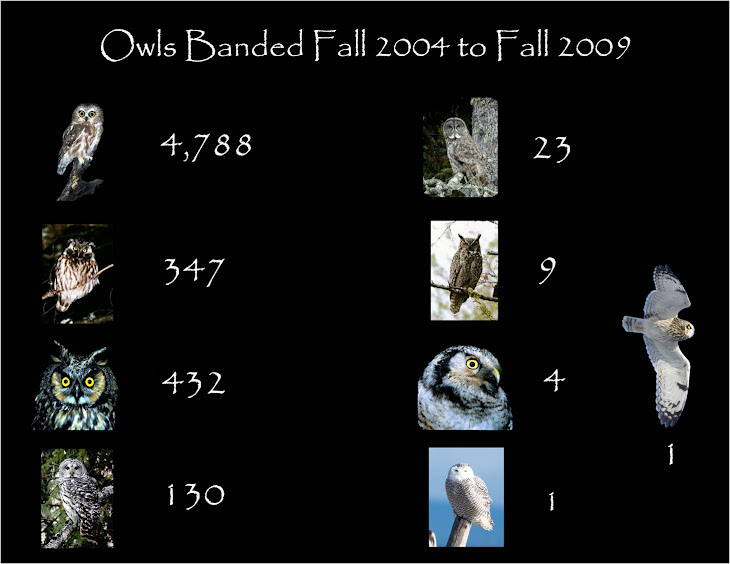
After the really nice push of birds during the first 3 nights of May, things really slowed down. During the last 3 nights 11 Saw-whets and 3 Long-eareds have been banded. An adult Saw-whet banded last summer was also recaptured.
Long-eared vs Short-eared

Long-eared on left & Short-eared on right.
There is an owl related identification issue that comes up every spring. How do you tell a Long-eared (LEOW) from a Short-eared (SEOW) in flight? This becomes more difficult, often impossible, as night falls. In the spring as many as 80 LEOW/SEOW have been seen during a single evening owl flight. At Whitefish Point it is assumed that the vast majority of these are Long-eareds. From spring 2007 to the present date 245 LEOW have been banded in the spring, but the SEOW banded on May 1 was just the 2nd to ever be banded by WPBO. Typically only a handful of SEOW are seen, and these are typically seen by the hawk and/or waterbird counters. That being said, both species occur here and this often poses identification issues.
These species represent the two North American owls of the genus Asio. They are extremely similar in shape and flight style. However, SEOW have slightly pointier wings, and are heavier than LEOW. These factors result in SEOW often appearing more steady, and slightly less buoyant in flight than LEOW. Given proper looks these species are easily seperated by plumage. However, there are plumage variations within both species that can make identification from a distance or with just a quick view more difficult.

LEOW: Probably a male. This bird lacks the buffy tones of many LEOW on its underparts. As in all LEOW the dark barring extends from the breast through the belly. The facial disk of Long-eareds is very often more richly colored redish-brown than on SEOW, but some males are very pale.

SEOW: Streaked underparts, streaking is thickest on the breast, becoming thinner on belly. The buffy color on the underparts extends to the belly on this individual.

SEOW: This is a pale individual. The heavy streaking and buff tones are limited to the head and breast. The streaking becomes thin along the flanks and belly. Also notice the pattern of the black in the wingtips and the carpal patch, the black spot between the bend in the wing and the wingtip.

SEOW: Another pale bird. The "raccoon eyes" shown by SEOW are quite visible in both of the above photos. Again, notice the thin streaking on the belly.

LEOW: This is a buffy female. The rich coloration and barring on the breast and belly are strikingly different from the SEOW pictured above. However, note that LEOW show a large carpal patch. Field guides regularly mention the carpal patch as a field mark for SEOW, but often state that it smaller on LEOW, or simply omit it all together. Also note that like the LEOW, all owls with ear tufts fly with their tufts down.

LEOW: A paler bird, but the barring on the underparts are very different from the streaking on a SEOW. Notice how pointed the right wingtip looked as this bird was gliding into a headwind.
The above photos show how strightforward identification can be when afforded good looks in ideal conditions. However, these birds are often seen fleetingly, distantly, or during the evening flight when no plumage detail can be seen.

As stated earlier, SEOW have slightly more pointed wingtips and are a bit heavier than LEOW. This means that on average SEOW tend to be slightly steadier in flight than LEOW. That being said, these birds are extremely similar in shape and flight style. Think of it as trying to tell a Broad-winged from a Red-shouldered, or a Peregrine from a Prairie Falcon as they fly by at night. The bird on the left in the above composite is a SEOW. The middle and right photos are both shots of single bird. This bird was photographed during an evening owl flight, and is most likely a LEOW. It does illustrate how a bird can shange the shape of its wingtips within seconds as it goes from a soar to a glide.
I'm sure this is enough for most of you. I suspect most stopped reading before here. However, for those of you who are saying, "don't stop now, I was almost asleep", there's more on the variation among these species below.
 LEOW: A particularly buffy female. Notice especially the buffy tones in the secondaries, and the underwing & undertail coverts.
 SEOW: Note the pointier wingtips when compared to LEOW. This bird is paler than the female LEOW above, but buffier than the male LEOW below. Also note the dark wingtips with fewer dark bars on outer primaries than on LEOW.
 LEOW: A pale male, very white in the underwing and undertail coverts.
The 3 photos above demonstrate how the blanket statement made by some field guides that LEOW are buffier than SEOW is misleading. LEOW may be buffier on average, and females are often much buffier than any SEOW will be, but males may be paler than some SEOW.

SEOW upperside: Note that the tawny coloration of the panel at the base of the primaries continues through the secondaries, and throughtout the spotting and streaking of the upperparts.
 LEOW upperside: LEOW are darker overall than are SEOW. The buffy patch at the base of the primaries is often smaller than on SEOW, but this is variable.

 Saw-whet & Great Gray Owls